The Neurolinguistic Paradigm Shift
As is the case in the physical sciences, I believe that linguistics proceeds in a pattern of punctuated equilibrium, those punctuations being paradigm shifts whereby the foundations of accepted theory are rewritten. In this way old mysteries become puzzles, explanations become more elegant, and new technological advances are enabled. Here I will briefly sketch the idea that generative linguistics should be reformulated in terms of quantitative neuroscience, and that such a reformulation will be immensely fruitful.
Perhaps the most salient example of a (relatively) recent paradigm shift in linguistics is the advent of the generative tradition, spearheaded by Noam Chomsky. Instead of remaining content with a Saussurian tabulated description of language and grammar, Chomsky brought to the fore a theoretical program in which transformational rules build up the set of grammatical utterances. Saussure's monolithic grammar was replaced by a description machine that can bootstrap its way to a description of a whole grammar.
The founders of the generative tradition overtly cautioned readers not to interpret the constructs posited by their theories as existing within the flesh-and-blood speakers of a language. Rather, the lexicon and the various layers of phrase-structure, transformational, and morphophonetic rules were to remain purely theoretical shortcuts for arriving at a concise description of observed language and of native speakers' responses to grammaticality tests. But since the 1960s linguists have broken these ground-rules and weighed in on questions of the implementation of language in the mind. Chomsky's Universal Grammar (UG) is perhaps the best example: syntacticians have reasoned that the so-called poverty of the stimulus implies that we must be born with a certain grammatical capacity. Regardless of the validity of the theory, the advent of UG marks a turning point in the linguistic paradigm away from a purely descriptive theory and towards a functional theory of language.
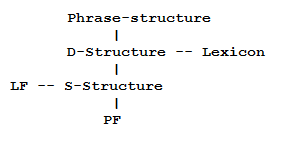
In reading Chomsky's Minimalist Program, I was excited to discover this block diagram, which dissects the theory of syntax into discrete levels of representation. Here the phrase-structure creates core sentence structures into which lexical items are inserted from the lexicon to form the so-called "deep structure". Then by a process of transformation one arrives at "surface structure" which is further transformed into a "phonological form" to be spoken or heard and a "logical form" similar to a philosopher's truth function. This structuring of the theory has proven fruitful within the study of syntax, so I ask, is this how language really works? Are there corresponding structures in the brain?
Researchers studying practitioners of sign language using hemodynamic imaging techniques have been able to shed some light on how the S-structure-PF interface might be structured. This research is in the right direction, but fails to attract me too strongly because it lacks a quantitative basis. However, recent advances in our understanding of the neurological underpinnings of vision is an enticing analog: If we could map out not only the regions of the brain which process the various stages of linguistic representation, but actually reverse-engineer the neural code for phonemes, morphemes, θ-roles, and other fauna of generative theory then we will be in a new paradigm indeed. With such a basis in neural codes we can give (or at least formulate a way to compute) precise answers to questions such as "How are word meanings stored in the brain?" and "How can one program a computer to understand English?". Surely traditional linguistic reasoning, computer modelling / NLP, and psychology will play roles in the new linguistic paradigm, but we should look to quantitative neuroscience for the most functional, and therefore most deeply satisfying, answers to linguistics most pernicious questions.
Originally published on Quasiphysics.