Speech-Transcript Alignment
A method for aligning a transcript to recorded speech is described, motivated by the need for alignment of audiobooks for use by SLA software. A combination of text-to-speech technology, mel-spectrum feature extraction, and dynamic time warping are employed to obtain a word-alignment for the input speech sample.
Motivation
Several practical applications require speech-to-transcript alignment, including synchronizing lecture videos with transcripts for subtitle generation. Here we focus on a more technically approachable problem: the alignment of audiobooks with the original text. The goal is to support language learning software that enables users to navigate audiobooks through on-screen text interaction.
Procedure
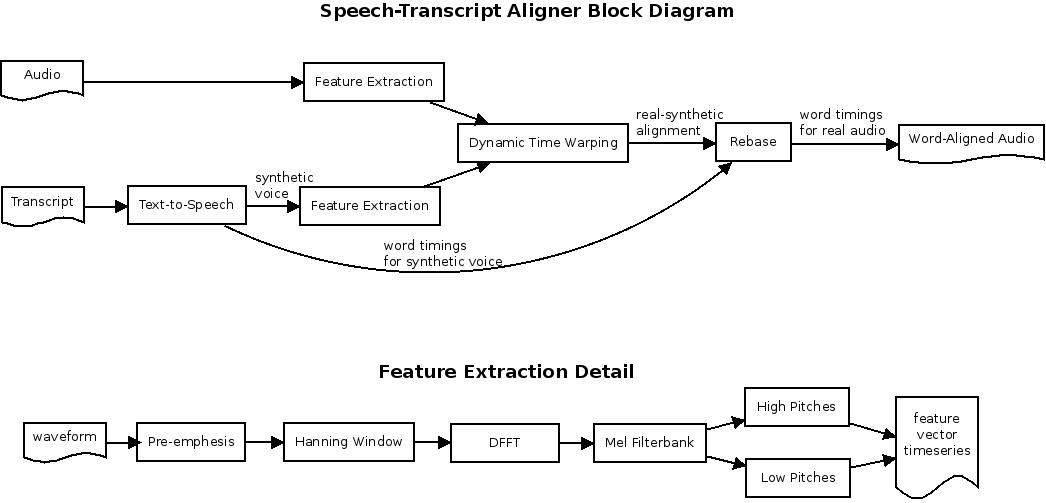
Block diagram of the alignment procedure.
Step 1: Text-to-Speech Processing
The transcript is run through eSpeak, a free, open-source text-to-speech program. This generates synthetic audio along with metadata containing word timing information, stored in JSON format.
Step 2: Feature Extraction
Both real and synthetic audio undergo processing similar to standard MFCC analysis. We apply a pre-emphasis filter to the entire waveform, then break the waveform into frames by applying a 25ms Hanning window every 10ms. A DFFT converts frames to the frequency domain, and a 32-element Mel filterbank converts to mel-space.
Feature extraction produces two scalar timeseries from each audio stream: "high pitches" (capturing sibilant phones) and "low pitches" (capturing voiced phones).
Step 3: Dynamic Time Warping
The mlpy DTW implementation aligns the feature timeseries. The "low pitches" feature was selected for best performance.
Step 4: Word Timing Rebase
The frame alignment from DTW is used to rebase the synthetic voice word timings into the real voice time domain.
Results
Test audio: A Scottish male speaker reading: "Which way shall we go to Lochwinnoch? One way is seven miles, the other way isn't quite so far, but I don't want to take the car on that bad road again."

Resulting word-alignment displayed as annotated spectrogram. Accuracy appears good, however greater precision could be obtained with additional features.
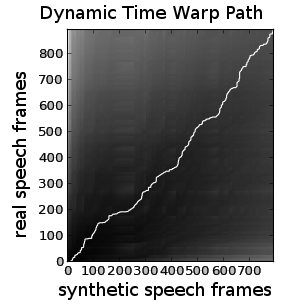
Dynamic time warp path for alignment of real speech features to those of the synthetic speech.
Analysis
The results demonstrate overall accurate alignment. Greater precision could be obtained if additional features (such as "high pitches") are allowed into the DTW alignment step, requiring a multi-element DTW implementation.
Future Work
Planned extensions include:
- Implementing multi-element feature vector support in DTW
- Aligning audiobooks in multiple languages (potentially Grimms' Fairy Tales)
- Creating aligned speech-text pairs across language translations
- Developing SLA applications for phrase translation exploration
Originally published on Quasiphysics.